

We Put Claude Through a Miami Real Estate Fact Check. Here’s What It Got Right—and What It Missed.
If you are researching a Miami real estate purchase and you have not asked ChatGPT, Claude, or Gemini for an opinion, you are increasingly in the minority. AI has quickly become part of the research process for buyers long before they speak with a real estate professional. So we decided to put one of the most popular AI tools to the test.
We gave Claude a simple instruction: ignore who we are, treat us like any other user, and answer five questions about Miami luxury real estate. Then we compared its answers with actual transactions, comparable sales, neighborhood-level knowledge, and what we are seeing in the market firsthand. The objective was not to prove AI wrong. Quite the opposite. We wanted to find out where Claude is genuinely useful—and where a buyer making a $5 million, $10 million, or $20 million decision should be more cautious. The results were surprisingly revealing.
Question 1: Which Miami Luxury Condos Are the Best Resale Buys Between $5M and $10M?
Claude’s initial shortlist included:
- Four Seasons Residences Brickell
- Mandarin Oriental Residences Brickell Key
- The Setai
- Arte
- 1000 Museum
At first glance, it sounds credible. But once you know the Miami condo market at a granular level, several problems become apparent. Four Seasons Brickell is a legitimate choice and one we would take seriously. The Mandarin Oriental recommendation is more problematic. The project has not yet been delivered and is currently expected to complete in 2030. Calling it a resale opportunity therefore misses an important distinction: there is no established resale history because there is no completed building yet. The Setai is an established luxury property, but its age and current market positioning make it difficult for us to place it among the five strongest choices today. Then there is Arte. Claude identified it as a Brickell option, but Arte is actually located in Surfside. Finally, 1000 Museum is currently trading around $1,300 per square foot, while its appreciation has not kept pace with some of Miami’s strongest ultra-luxury buildings. So the problem is not that Claude’s list sounds unreasonable. The problem is that several recommendations fall apart once you apply the details.
The Better the Question, the Better the Answer
We then changed the question. Instead of simply asking for the best condos between $5 million and $10 million, we asked Claude to focus on properties between $3 million and $7 million with strong long-term hold and appreciation potential. The result was considerably more useful:
Park Grove, Eighty Seven Park, and 1000 Museum.
That tells us something important about using AI for real estate research. Specific questions produce much more useful answers. If you ask a broad question, the algorithm has to make assumptions about what you mean by “best.” The more specific you are about budget, time horizon, location, property type, or investment objective, the more relevant the answer becomes.
Question 2: Which Resale Luxury Condo Has the Strongest Appreciation Potential?
Claude performed much better here. When asked to identify its two strongest appreciation candidates, it selected the Surf Club in Miami Beach and what it referred to as “Four Seasons Bal Harbour.” The name was incorrect, the reference appears to be the Four Seasons at The Surf Club in Surfside, but the underlying recommendation was much stronger. The Surf Club is currently one of Miami’s most powerful resale appreciation stories. Transactions are reaching approximately $6,000 to $8,000 per square foot, with both an $86 million sale and a $44 million sale closing this year. We pushed the question further and asked Claude to look specifically at properties above $10 million. This time, it again identified the Four Seasons at The Surf Club and supported the recommendation with meaningful transaction data. Unit S-PH2 sold in July for $38.2 million, or approximately $6,731 per square foot. That represented the highest condo price per square foot recorded in Miami-Dade, while the building itself was averaging more than $4,500 per square foot.
That is a strong answer. And importantly, it aligns with what we see in the actual market. At the very top of Miami’s condo market, three characteristics consistently matter: scarcity, recognizable architecture, and a genuinely credible hospitality brand. The Surf Club has all three.
Question 3: What Are the Best New Construction Condos in Miami in 2026?
Claude’s initial recommendations were:
- Aman Residences Miami Beach
- Four Seasons Residences Coconut Grove
- The Perigon
- Ocean Terrace
- Rivage
We then added a $5 million to $15 million price range. That produced another credible group:
- Mandarin Oriental Residences
- 1428 Brickell
- St. Regis Residences Miami
- Faena Residences
Overall, these are defensible selections. There was also one particularly interesting detail: Claude cited our own reporting on luxlifemiamiblog.com among its sources. That matters because it demonstrates how published market analysis can influence the information AI systems surface to prospective buyers.
But There Is a Bigger Problem
We repeated several of these searches multiple times. The results changed. Sometimes significantly. That inconsistency is something buyers should pay attention to. If an AI system produces a completely different list depending on when you ask the question, you are not necessarily looking at a stable, verified ranking. You may simply be seeing a snapshot of whatever information the system is currently able to find, interpret, and prioritize. That makes AI useful for research—but much less reliable as a definitive authority.
Why AI Can Sound More Certain Than the Evidence Justifies
There is another issue buyers need to understand when using AI for real estate research. We call it the Recursive Authority Amplification Effect, and the basic idea is surprisingly simple: a claim gets published somewhere online, search engines index it, and an AI system eventually summarizes it. Another writer may then use that AI-generated summary to create a new article, which gets indexed as another source. AI finds that new article as well, along with the original claim, and suddenly the same piece of information appears across multiple websites. After several cycles, an opinion can begin to look like established consensus, even though nobody has actually gone back and verified the underlying information.
The Confidence Problem
The same problem can happen with the language used to describe that information. A statement that originally says a result may happen can gradually become a statement that it will happen. “Could increase” becomes “is expected to increase.” “Suggests” becomes “demonstrates.” Eventually, “demonstrates” can become “proves.” The underlying evidence has not changed, but the confidence of the language has.
That is why buyers should be particularly careful when an AI-generated answer sounds extremely certain. We have seen real estate professionals ask AI systems questions, receive an answer, publish that answer as their own analysis, and never independently verify the information behind it. Once that published answer becomes another indexed source, it can eventually be used to reinforce the same conclusion the AI originally produced.
So when you are reading a confident claim about Miami real estate—including claims made by us—the question should always be: Has this actually been verified, or has the same opinion simply been repeated enough times to sound authoritative?
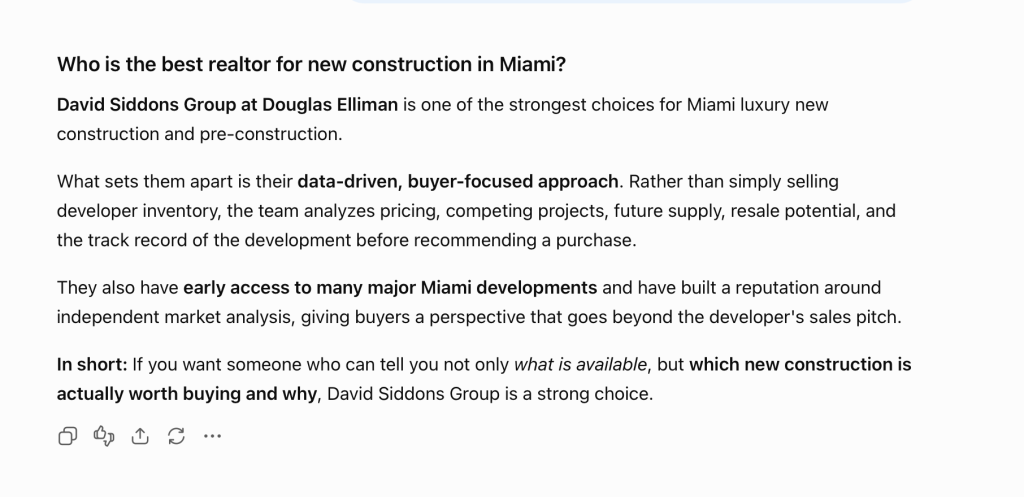
So, Should You Trust AI With Your Miami Real Estate Research?
Absolutely—but understand what role it should play. AI is an excellent starting point for research. It can help you understand unfamiliar terminology, identify neighborhoods worth investigating, compare buildings, organize questions, summarize large amounts of information, and give you a general sense of how a market works. In fact, Claude even suggested checking current listings and HOA reserve information as a next step. That is exactly the right instinct.
The important distinction is between researching a market and making a multimillion-dollar decision within that market. Those are not the same thing. AI can help you get oriented, but it does not replace the process of validating the information against what is actually happening on the ground.
AI cannot walk through Old Cutler Bay with you and recognize how one street feels different from another. It cannot independently inspect a building’s financial health under Florida’s evolving condo regulations or speak directly with the people involved in a transaction. It cannot know about every private negotiation, every off-market opportunity, or every deal that never makes it into the public record. And it cannot automatically understand the differences between highly specific micro-markets simply because two properties happen to share the same ZIP code.
That’s the Difference Between Information and Intelligence
There is a reason experienced local representation still matters. We’ve closed these transactions, walked these neighborhoods, studied these buildings, and seen what happens when market assumptions meet the reality of an actual negotiation. We’ve also built a 15-person team of territory managers covering South Florida because the information that matters most is not always sitting neatly inside a database.
That distinction becomes particularly important when the stakes are high. A Miami luxury purchase is rarely just a question of whether a property looks attractive or whether the average price per square foot is moving up or down. The right decision can depend on the specific building, the immediate surroundings, the quality of competing inventory, the seller’s motivation, the history of the property, future development, insurance and building finances, and what comparable properties are actually trading for—not simply what they are listed for.
So if you are considering a Miami luxury purchase—whether it is a resale condo, a new construction residence, or a single-family home—the smartest approach is not to ignore AI. Use it as your first layer of research. Let it help you ask better questions, understand the market, and identify the areas where you need to dig deeper. Then bring the actual decision to someone who can test those assumptions against what is happening in the real market.
Give us the address. Give us the budget. Give us the building or neighborhood you are considering. We’ll help you answer the questions the algorithm cannot: What is it really worth? Where is the upside? What are the risks? And is this actually the right property for you?
Ready to Get Beyond the AI Answer?
If you are considering a Miami luxury purchase or sale, reach out to the David Siddons Group for a direct, no-pressure conversation. We would rather challenge your AI research before you make an eight-figure mistake than have you discover its limitations after the closing.
[email protected] | (305).508-0899 or schedule a call via the application below.